Go to.. Classroom...
Cloth Dollmaking for Everyone
© 1998, © 2012 Judi Dolls/Judi Ward
Taught by Judi Ward of Judi's Dolls
http://JudisDolls.com
…A Brief Introduction…
A First Note….This class was originally written "before digital camera" Much is hand drawn and hand colored or put in the scanner.
Drawings are very accurate, and also let
you imagine to a greater extent than photos do.
What I wish to convey with this class, is that the abilities are there for almost anyone to make quality cloth dolls. What is often lacking are the techniques and skills needed.
You have decided you want to make a cloth doll. You get a pattern and never know what to expect. Or perhaps you have bunches of patterns and have tried to make dolls from them, but get stuck for lack of some little skill.
The other thing lacking, especially for beginners are the resources and knowledge about supplies. What is a sculpture needle? How big is it? What difference does it make if you make a doll from woven fabric or knit fabric? What kind of yarn or fiber for hair?
Perhaps it’s stuffing, Oh dear! You have heard it’s best to stuff with tiny little pieces, or was that big pieces? Do you need the expensive polyester stuffing, or is the cheaper stuff good enough? What to do? Which is it? Why does it make any difference?
Perhaps it’s a sewing skill, for assuring smooth curves and
of course those wonderful tiny fingers! How do you sew something so small? What
kind of thread, needles, stitch length etc.
The patterns usually don’t give all the information you need to make a really
high quality doll. They can’t possibly include all of the little things you
really need to know. If they did, every pattern would be a book! And no one
could afford them.
I want to start this class at the very beginning of the Cloth Doll Adventure. I want to include everything I can possibly include, based on my many, many years of dollmaking and designing experience. Some of what I will include will bore the pants off of more advanced dollmakers, but you may still pick up some tips you didn’t know you needed!
For the true beginner, we will start with the very basics. If you progress through, with all of the lessons and PRACTICE, you will be able to make high quality, detailed cloth dolls by the end of this class. You will all be able to use the lessons for all kinds of doll patterns. The skills and techniques are not only useful for the dolls we will make in class.
PRACTICING ON SOME OF THE FINER SEWING AND STUFFING TECHNIQUES WILL BE CRITICAL TO THIS LEARNING PROCESS. PRACTICING THE FACE TECHNIQUES WILL BE CRITICAL TO MAKING LOVELY DOLL FACES. There is a very in depth class on face painting at Doll Net/Crafty College too.
If you try something only once and then give up, it will never become easy or even easier. Lots of the skills used in cloth dollmaking are an “art”, but for the most part it is an “art” that can be learned.
Lets talk about:
…QUALITY…
I frequently hear the statement about cloth dolls, that the “feelings portrayed” are the most important aspect of cloth dollmaking. I have heard it said that quality doesn’t really count, as long as the “feeling” is there.
“Feelings”, “Ideas” and “Concepts” can be portrayed within the context of quality workmanship. There are no prestigious cloth dollmakers doing poor quality work. There are no cloth dollmakers selling at shows doing poor quality work. Quality is achievable by any cloth dollmaker who desires to achieve it.
There are no challenge winners doing poor quality work either.
If these artists produced dolls with threads hanging, seams warped, seams split, bumpy stuffing, poorly made clothes, smeared faces, mismatched limbs, etc. they would not be where they are.
When you enter challenges and contests, the judges look for quality. The overall look is taken in at a glance, and then the doll is “picked apart”, not literally, but the judges look for quality workmanship. They look for clean lines and seams, neat closings, proper stuffing techniques for the doll type, good color composition, etc.
If you work hard on quality, your dolls will be winners.
…CREATIVITY…
Whether you are making a doll from a pattern, or your own design, your creativity can be expressed in so many ways. From color choice to trimmings. From face design (or no face at all) to hair.
How you pose your doll, or accessorize it, will be your
decision, and an avenue to creativity.
As you progress in your dollmaking, your creative side will emerge more and
more, as the “technical” stuff becomes easy.
Try very hard, very early in your dollmaking to get away from the “it has to look exactly like” syndrome.
If you tend to see a doll only one way, and try to duplicate it exactly, you will more than likely be less than satisfied with the results.
If you have made dolls from patterns, you will observe that no two are alike, and they never look “exactly” like the photo or drawing. That is because your style and creativity shine through, no matter how hard you try to make an exact duplicate.
This aspect of cloth dollmaking is very desirable, and a great deal of the reason people are drawn to cloth dollmaking, over hard mediums like porcelain.
If you see a doll dressed in all bright colors is that the only way you can visualize it? If it has red hair is that the only way you can visualize it? If you see a photo or drawing on a pattern cover for clothing for yourself, do you try to find the exact fabric shown in the drawing? If you find yourself doing this, it is time to break the habit and venture forth in a different direction. The “exactly like” syndrome is the biggest stumbling block to creativity!
The patterns that we will use for this class are all very
versatile, and progress through many steps towards detailed dollmaking, but
they are not static. I won’t tell you what colors to use for anything. You will
be taught variations that are interchangeable. The clothes on the dolls
pictured are a variety of colors and prints. I encourage you to choose a
completely different variety. Perhaps all solid colors, or perhaps mix and
match prints or a combination of both.
If choosing clothing fabrics is a stumbling block for you, go to a fabric shop
and have the clerk help you make some nice combinations. Then change at least
one fabric in the combination, to one completely of your own choice. This is a
great place to start looking at things with an eye for color and compatibility.
By choosing at least one fabric different from what someone else suggests, you
will be on your way to being able to create color combinations with a look that
is your own! It is fun to decide on the fabrics for a doll. The more you do it,
the more confidant you will feel. Perhaps you prefer muted, soft colors.
Perhaps it is bright primary’s or autumn hues. Whatever it is, strive to make
the choice yourself, no matter what the picture shows!
Below are some nice combinations of fabrics. If you have a color printer, print them out and mix and match to come up with some other combinations. I just pulled an assortment from my “stash” and started mixing and matching, to make coordinated combinations. Many more combinations can be made with these few fabrics too.
A very dramatic doll can be done in all one
color, with the fabric textures creating interest.
Pull a selection of fabrics out of your “stash” and cut them in little squares
to do some mix and match practice.
Combinations of Fabrics Below…
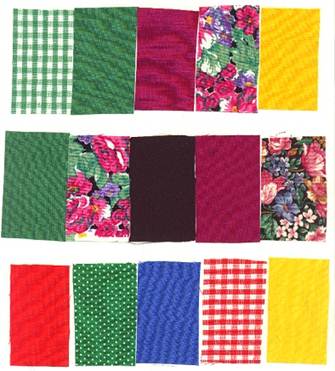
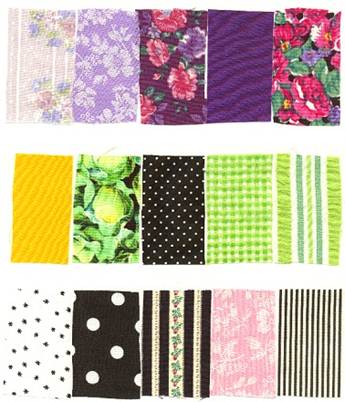
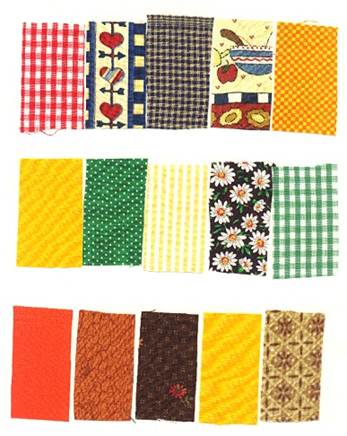
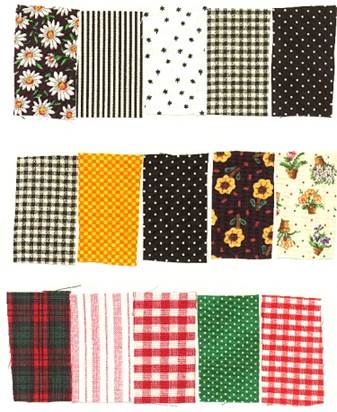
Of course not all dolls call for an assortment of prints and colors, but many do, so this practice is fun, if all of this “color” stuff is new.
I will now step down from my soapbox, so we can begin this adventure into cloth doll making. Learning lots of methods and techniques for making quality cloth dolls. From simple to detailed!
Additions, corrections, and information changes since 1998
As I was editing the “Cloth
Dollmaking For Everyone” class I realized that there are several things that
need to be updated.
Fabrics…Craft Velour is still available and is easy to find online.
Dollmakers Journey, Joggles, CRs Crafts are 3 places to find it.
DOESUEDE no longer exists. It
has been replaced by several other suede like fabrics available at the above
places too. One called Deer suede is the best in my opinion. It is lighter weight,
and more like OLD DOESUEDE.
The above fabrics DO NOT
stretch much at all and in fact I have used woven cotton that stretches more.
The above fabrics do not fray or pull apart, and they make slim fingers a cinch
to turn. They also eliminate finger pops.
Threads…When the class was first written the only thread that
held up to strong stuffing and such was Metrosene. Since that time Coats and
Clarks has improved a lot and Guiterman has too. I use them all now.
Stuffing…The best stuffing
now is Buffalo Bat, Putnam and 100% wool. At Christmas time there is a Buffalo
Snow put out for decorations that is GREAT for dolls too.
In the class, I suggest
cotton balls in the long tab necks, which is still good….unless….you are going
to use the string method of jointing the neck. I presented that concept to the
dollmaking industry 13 to 15 years ago, and it is used a lot now, but if you
haven’t used it, directions are towards the end of this class. Don’t use
cotton balls in a neck if you are going to joint the neck this way.
The Patterns…Each doll
pattern is a “stand alone” pattern. Because of this, there is a lot of overlap
of basic directions. If you just print and make Jennifer, her pattern and
directions will be complete, even if you make no other dolls.
There are 2 sheets that have
been extras with my patterns for about 30 years! Invisible Jointing
directions and a sheet called Hints and Helps. Those 2 sheets are here too.
There is also a U-Tube video
for invisible jointing.
The basic, skills lessons
in this class apply to all of these dolls and many, many other doll patterns no
matter who they are from.
Good, Basic dollmaking skills
are needed for all cloth dolls, and Good, Basic Options are great to have too.
Always approach cloth dollmaking with an open mind to the personality that may pop out of a doll in progress, and always use good skills so whoever pops out is a quality work of art.
This Class has been called “The Cloth Dollmakers Bible” by many hundreds of students over the years and I hope it will continue to let cloth dollmakers achieve their best dollmaking skills with any doll they make.
Hugs, Judi
Judi Ward
Judi's Dolls
Go to.. Classroom...
Copyright Notice: All pages and graphics are copyrighted by the Internet Visions Company and/or Judi Ward. You may print these out for the use of the class only. All other uses or distributions are forbidden.
Crafty College and Doll
Net are Divisions of
the Internet
Visions Company.
© 1998-2017, Internet
Visions Co. All rights reserved.
All trademarks are owned by Internet Visions Company.
http://JudisDolls.com http://DollNetMarket.com